


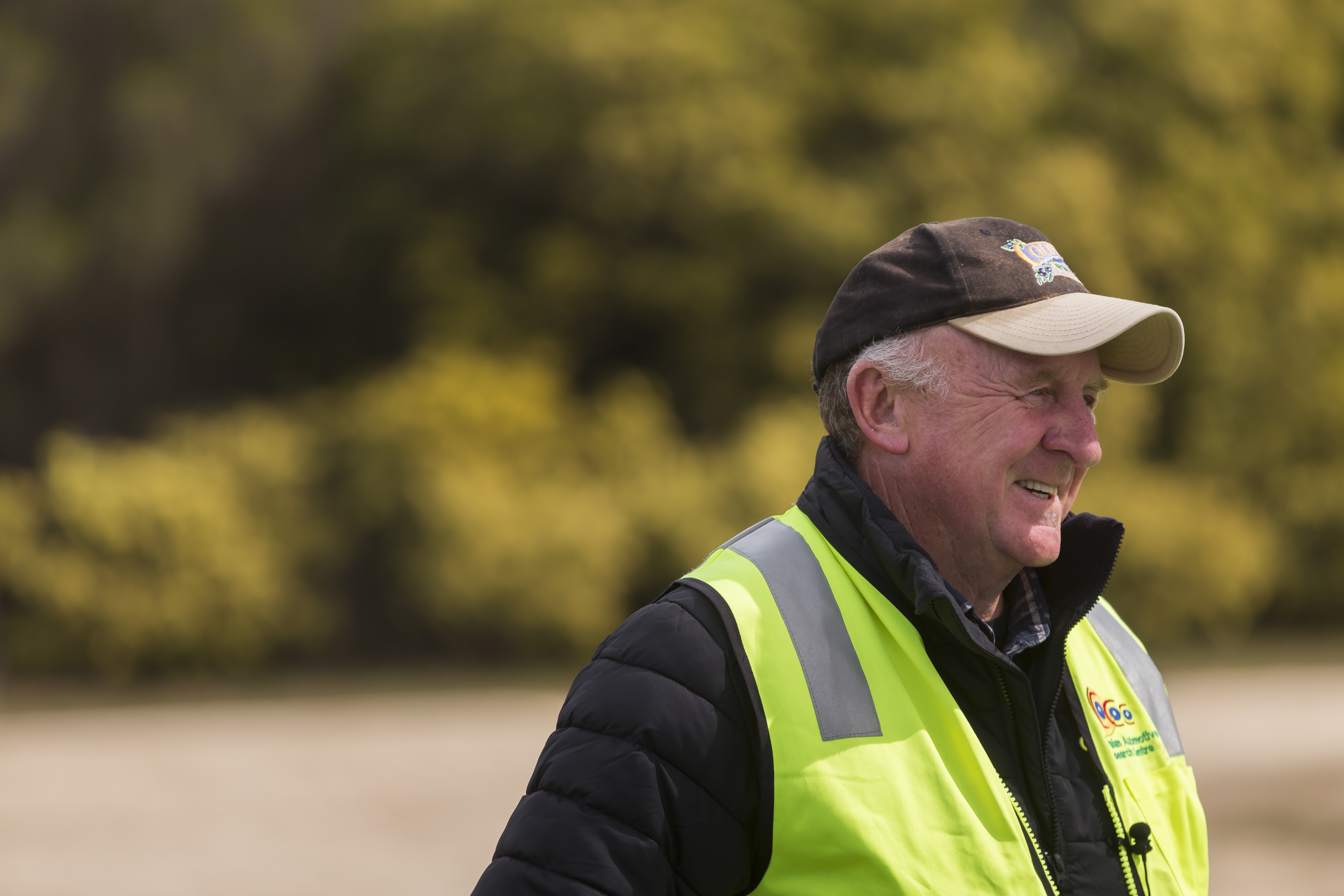


It’s a big jump from the rolling farms of eastern Australia to the dairy flats of Western Australia’s south-west, but distance certainly hasn’t fazed Scott and Regina Harvey’s horizons. Yet while the cost on heart and home has been brutally tough at times, nothing has broken the bonds that keep this enduring partnership firing on all cylinders
It’s not so much what Regina Harvey says, it’s how she says it. It’s the tone. The vibe.
Like, in much of modern society, reflections on the reasons for separation and divorce invariably come with lashings of vitriol and virulence. But not in this case. Not in this woman.
There’s simply no animosity, or at least none apparent. Likewise, and perhaps most notable of all, not a hint of the belligerence or simmering enmity that so often steams from such events. Not even a whiff.
Instead, there’s a genuinely warm humour, a calm solace and a reassuring acceptance that it’s probably best to leave problems in the past and simply move on. Get on with living. Let life run its course.
He is his own man. Always has been. What you see is what you get.
“Sure, it wasn’t easy at times. We’ve had our moments, definitely, but it is what it is and we’ve learned to live with it,” Regina says thoughtfully, quickly adding, “But we’ve still managed to at least like each other.”
A short pause, a savvy smile. “Most of the time.”
Sitting alongside in the office of SRH Milk Haulage’s West Australian operation just outside Bunbury, about 160km south of Perth, Scott Harvey chuckles loudly.
As anyone who knows him will attest, he does lots of things loudly but on this occasion, as with many other moments noticed over the past few days, he looks at his business partner and former wife with something far more fluid, more tender than just idle humour.
Affection perhaps, or even a moment of pensive remorse? It may well be a bit of both but whatever it is, it’s obviously mixed with a massive dose of regard for the woman whose strength and support have been paramount in almost every aspect of his life.


Scott and Regina were first cast together as hot-blooded and headstrong teenagers from the NSW Hunter Valley, unsure of exactly where they were going but determined to go together
Then, seemingly from deep within the inner confessional, he cracks that crevassed grin and blurts, “I wasn’t the best husband at times.”
It’s a burst that sets them both giggling, perhaps for distinctly different reasons. But in the next breath it’s a totally serious Scott who says bluntly, “No, I mean it. We talk just about every day and above everything, she is still my mate. Always will be.”
And the way he sees it, mates stick. No matter what.
It’s a candid comment that earns a soft smile from the woman he simply calls Reg and at this moment, it’s apparent something very personal, incredibly stoic has seeped into the conversation. Indeed, it feels a privilege, even a tad invasive, to watch and listen to the interaction. True, the marriage is done and dusted but it’s blatantly apparent there’s a bond here as solid as the concrete under our feet.
No question, time and tempest have carved cracks in the concrete. Yet equally, and as vivid as the lavish mullet flowing off the back of his head, there’s still steel holding all the pieces together; a steel first cast in what they openly concede were hot-blooded and headstrong teenagers from the NSW Hunter Valley, unsure of exactly where they were going but determined to go together.
No question, Reg has been the balance I’ve needed at times. Still is.
In Scott’s case, hot-headed might be also appropriate and it’s obvious the loud larrikin of youth has not been completely subdued by time or toil.
As Regina casually puts it, “He is his own man. Always has been. What you see is what you get.” Later, with Scott out of earshot, she also quietly asserts that there’s far more to the man than meets the eye or mangles the ear.
Experience, for instance, has been a tenacious teacher for Scott Harvey and despite the mullet, the gravelly and sometimes raucous voice, the fierce work ethic and general impression of a life lived hard and to the hilt, innate business acumen has accrued along the way.
Nor have initiative or a constant eye for opportunity waned with the passage of years though they both admit that the illness and subsequent loss last year of Scott’s 86 year-old father Doug was a difficult time all-round, leaving a hollowness in the forlorn son not easily filled by work or much else.
It was, they admit, one of those few times over the past 20 years or more when one or the other questioned the merit of keeping the business.


Scott’s prolific work ethic and attention to detail didn’t go unnoticed and it wasn’t long before dairy companies were encouraging and then insisting they either grow the business or get out
“But you get through those times,” Regina says abruptly. “We’re settled now, at ease. Things work out over time.”
The conversation seems to stop in its tracks for a few seconds before a surprisingly contemplative Scott Harvey admits, “No question, Reg has been the balance I’ve needed at times. Still is.” Again, a few seconds pass before the gregarious grin reappears, “Even when I didn’t think I needed it.”
This time, Regina just smiles thoughtfully. Once more, there appears a simple acceptance that over more than three decades as a couple, 27 years married, and despite difficulties both private and professional, the foundations have endured the shocks and tremors of a sometimes tumultuous existence.
From the outside looking in, there’s a shared pride in this pair that runs deep and strong, not least as parents of three children – daughters Blair and Ashlee and son Mitchell – and now their first grandchild, Blair’s daughter Maisie.
But of course, there’s also the creation of the business called SRH Milk Haulage, started inauspiciously with one truck in 1996 on home turf in the NSW Hunter Valley, only to emerge as one of the big players in a highly specialised field.
Something had to give, and it did. Us!
Obviously enough, SRH stands for Scott and Regina Harvey and as Scott emphatically exclaims, “It was a fifty-fifty partnership from the start and as far as I’m concerned, that won’t change.”
The mindset is mutual with an adamant Regina adding, “We started it together and we’ll see it continue together.”
For a willing and eager Scott Harvey in his late 20s, the opportunity to work for himself in the milk haulage business simply could not be ignored.
As he told me several years ago, “I always liked tanker work. The trucks and tankers just looked better, cleaner, and I liked that. Still do.
“Anyway, someone suggested I should run a truck of my own. The thought of that made both of us nervous but when a tender eventually came up, we went for it and got the contract.”


SRH Milk Haulage started inauspiciously with one truck in 1996 on home turf in the NSW Hunter Valley, only to emerge as one of the big players in a highly specialised field
Regina concedes, however, that she wasn’t quite as upbeat or excited about Scott’s move to owner-driver ranks. “My father was a truck driver and I’d seen the long hours and how hard he worked over the years,” she recalls, “so I wasn’t nearly as keen as Scott to run our own truck.”
But then, she says with a shrug, “Like I said, he is his own man.”
Over time, of course, SRH has evolved into a remarkably successful, high-profile business but typically perhaps, the start wasn’t without its memorable moments.
On the same day, for instance, that Scott proudly took delivery of their first truck, a new Volvo FH 380, a pregnant Regina was working as manager of a building society in suburban Newcastle when an armed hold-up took place.
“The same day,” she reflects with a strange mix of snarl and smile, “we had a massive storm but even after I’d told him about the robbery, Scott was more worried about hail damage to the truck.”
We had a massive storm but even after I’d told him about the robbery, Scott was more worried about hail damage to the truck.
Quiet for a second, she wrangles a wry grin. “Well, either way it was an exciting day.” Initially, with Regina’s head for money matters and Scott’s willingness for work, she says it was easy enough managing the one-truck operation and two small children – and another ultimately on the way.
Meantime, Scott’s prolific work ethic and attention to detail weren’t going unnoticed and as they both recall, it wasn’t long before dairy companies were encouraging and then insisting on a decision to either grow the business or leave the business.
“Bigger certainly didn’t mean easier,” Regina remarks, noting that while the rewards were greater so, too, were the risks in a company still in the process of building a sound financial footing.
“Managing money in the early days was an issue, for sure, and balancing the books was a constant challenge in a growing business,” she explains. “There was a lot of fancy bookwork going on in those days.”
Meanwhile, the days of running the business from a table at home and parking trucks in the street were also rushing to a close. By 2001 SRH had moved into a depot at Rutherford in the lower Hunter Valley, on the western extremity of Newcastle, which still remains company headquarters.


The SRH Milk Haulage business now comprises close to 200 employees, a fleet of 75 trucks and around 120 Tieman or Byford tankers moving more than one billion litres of milk a year
The story since then, of course, is one of steady but consistent growth, a fact which at times appears to astonish both Scott and Regina.
“I try not to think about it too hard. It can give me a headache,” Scott laughs, but the seriousness is not lost on two people now in their late 50s.
“There’s no way either of us thought it would ever grow to where it is now.”
And ‘now’ means a company with close to 200 employees, a fleet of 75 trucks and around 120 Tieman or Byford tankers moving more than one billion litres of milk a year.
Still, getting to this point hasn’t always been a smooth run. “There was a lot of pressure in running a business and a home with young kids,” Regina reflects.
There’s no way either of us thought it would ever grow to where it is now.
“The original plan, we thought, was to build the business for 10 years or so, then that became 15 years and obviously, that didn’t happen either.”
Bigger and Better
Family holidays were largely non-existent, Scott was away a lot and with a propensity for keeping his finger on the pulse of every aspect of an increasingly widespread business as well as a sharp eye for new opportunities, the pace of life was often frantic. “It took a toll over time,” Regina says simply.
Yet it’s at this point that Scott and Regina were quick to cite the fortitude of eldest daughter Blair working as national operations manager from Rutherford.
“She’s a child of the computer age,” says an admiring father. “Our customers are big companies and they expect our admin and software processes to be up to the standard of modern business practice. Blair is essential in achieving and maintaining that, but also in the technology that applies to trucks.”
The introduction across the fleet of the ‘Seeing Eye’ fatigue monitoring system was, he explains, a direct result of Blair’s initiative and technical nous.


A contract with Brownes Dairy put SRH on the map in the west and spurred development of the most advanced and arguably biggest road haulage milk tanker combo in the world
Throughout it all though, the foundation of the business has largely remained farm pick-ups with single trailers. Change, however, has been significant and nowadays, the SRH operation spans a wide swathe of country from bases as far afield as home base at Rutherford to Raleigh on the NSW north coast near Coffs Harbour, Poowong in Victoria’s Gippsland, to the other side of the country at Picton in WA, just a few kilometres outside Bunbury.
More recently, a new contract in south-east Queensland and extensions to existing work in Victoria and regional Queensland are set to expand fleet size and business horizons even further.
Consequently, farm pick-ups have in many cases become feeder runs for far more expansive roles best typified perhaps by the 3,000km, four-day return run from Cobram in Victoria to Labrador in Queensland with an A-double combination. It’s just the sort of run which has, in fact, helped fire Scott Harvey’s almost endless desire for bigger, more efficient combinations.
Flexibility is the key, he contends, but nothing and nowhere allowed the efficiency envelope to be pushed harder or further for Scott Harvey than an opportunity in 2012 to add Western Australia to the SRH stable.
It was a relatively low-key start in the west and with raised eyebrows and a knowing nod from Regina, Scott concedes the management and administration of an operation on the other side of the continent weren’t without a few hassles and hardships.
I always liked tanker work. The trucks and tankers just looked better, cleaner, and I liked that. Still do.
On the home front, the cracks became caverns and as Regina put it, “Something had to give, and it did. Us!”
Nonetheless, it was a contract with the historic Brownes Dairy operation which largely put SRH on the map in the west and ultimately, provided the platform for development of the most advanced and arguably biggest road haulage milk tanker combination in the world.
Brownes Dairy has been in the milk business for around 138 years and today collects upwards of 150 million litres annually from more than 50 dairy farms in WA’s south-west. The daily movement of all that moo-juice from the company’s holding plant at Brunswick Junction to a processing plant in Perth’s northern suburbs – a 360km round trip – is a significant undertaking and for Scott Harvey it was also the perfect application to push bulk milk haulage to an unprecedented leve
Enlisting the technical support and engineering expertise of Tieman Tankers in WA and Volvo’s Wacol factory in Brisbane, the flagship of SRH’s 15-strong WA fleet since June last year is a 15-axle road-train combination hauled by a Volvo FH700. The outfit stretches over 32 metres and with 73,000 litres of milk on board, grosses at 111 tonnes.
“It’s something special, eh,” Scott murmurs proudly as the combination took on another load in the early dawn. It truly is!


Volvo has been SRH’s preferred truck from the start. In fact, since kicking off in 1996, it has bought close to 300 new trucks and more than 250 have been Volvo
As the day unfolds though, it’s soon apparent that while farm pick-up work is the foundation here as in the east, ‘pocket road-train’ combinations are utilised wherever possible in an operation where trucks routinely notch around 300,000km a year and some up to 400,000km.
What’s more, it’s no shock to learn that other than a lone Mack Anthem, all the trucks in the WA operation are from the Volvo stable. While it’s certainly not the only brand in the overall SRH fleet – Kenworth, Mack, Mercedes-Benz and Scania also have a modest presence – Volvo has been the preferred truck for Scott and Regina Harvey from the start. In fact, since kicking off in 1996, SRH has bought close to 300 new trucks and more than 250 have been Volvo.
For Scott, the reasons are easily defined. “Volvo has been good to us, for sure, and overall we’ve had a good run but the best thing is it’s a one-stop shop and these days that includes contract maintenance on all new trucks and a finance package that’s hard to beat.”
Asked if distance has been a detriment to overseeing the WA operation, Scott appears to consider the question carefully before answering.
On the service side he explains that the work is done on-site by a company called LCD Mechanical owned by mechanic Luke Dale. “He’s a good young bloke who does good work and is prepared to have a go,” Scott says succinctly.
Managing money in the early days was an issue, for sure, and balancing the books was a constant challenge in a growing business.
“We own the workshop and put in the service pit so the way it works basically is that Luke’s business is our business and vice versa. I don’t mind if he works on other trucks as long as ours get priority.
“It’s working well for both us,” he continues, while pointing to an entirely new wash bay currently being built between the workshop and office area.
On the management of the WA operation, Scott says it simply comes down to trust in fleet managers Matt Cocodis and Adam Crane. “But we have good managers in all our depots and I can’t ask or expect any of them to make a decision, then not support them.
“How can you say you trust people to do something then undermine their decision? That makes no sense and besides, we all make mistakes. The thing is to learn and not make the same mistake again.”
It’s a comment that makes Regina crack a broad smile. Quiet for a few moments, she calmly declares, “There’s definitely a difference in Scott lately, especially since the loss of his father.


‘Pocket road-train’ combinations are utilised wherever possible in an operation where trucks routinely notch around 300,000km a year and some up to 400,000km
“He’s just more settled, more content. I suppose we both are.”
Scott nods. “Yeah, it’s good to step back and see the whole picture.”
By now we’d talked enough, perhaps more than any of us intended and they were keen to get back to Perth for a flight to Melbourne where Scott would look in on the Victorian operation before Regina headed north to resume her volunteer work with Ronald McDonald House and Riding for Disabled.
“C’mon Reg, we need to get going,” he says, pushing back from the table. “Yeah, in a minute,” she fires back.
Suddenly, the former husband and wife sounded very much like any husband and wife. C’est la vie.


