



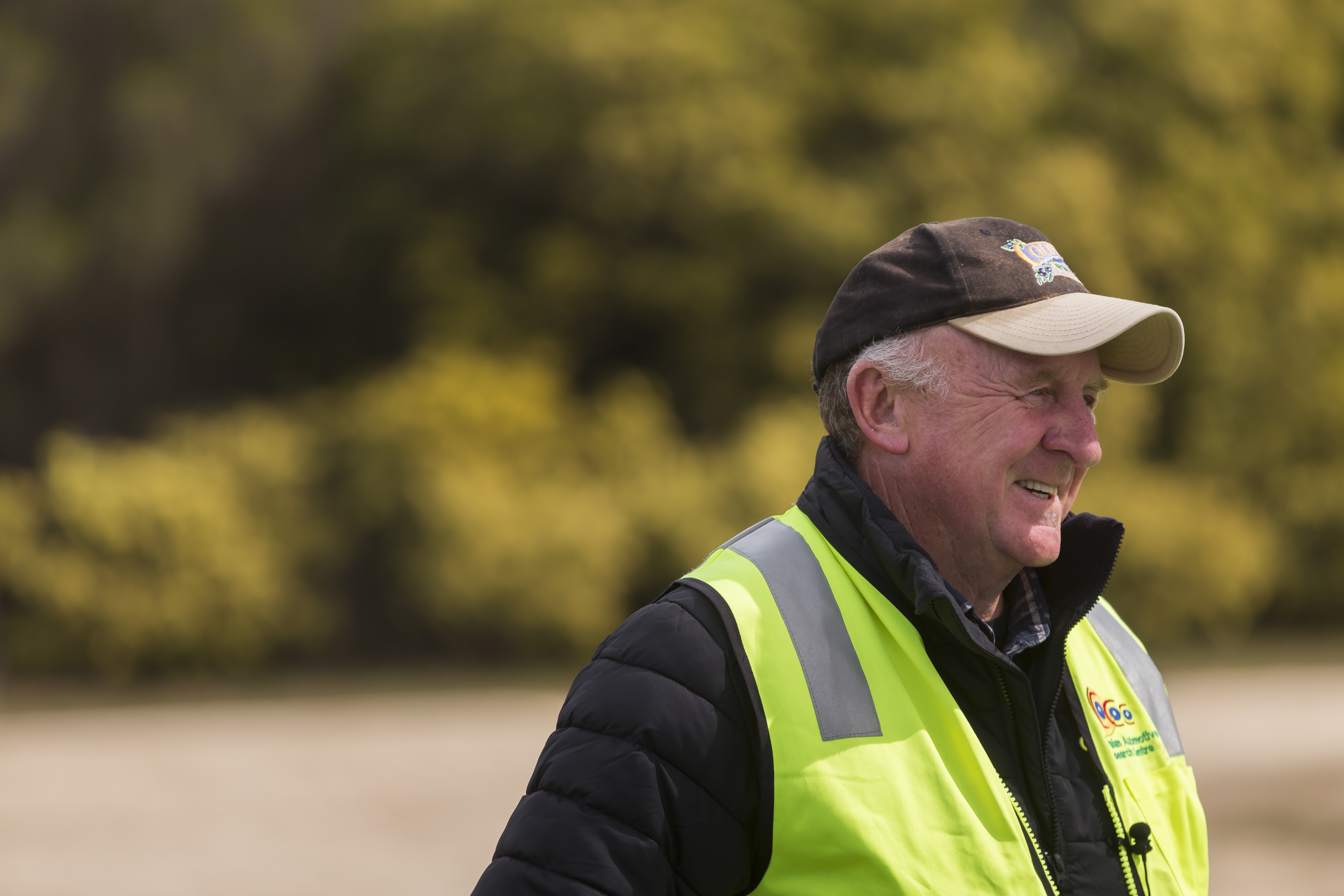

Melbourne isn’t short of showcases for sporting spectacles. ‘The Cup’ has Flemington, tennis has Rod Laver Arena, and AFL and cricket the mighty MCG. Yet long before the city’s Grand Prix can scream into action each year, a trendy inner-city oasis must be transformed into a world-class racing circuit. Just the thing to fuel two of Charlie Schwerkolt’s prime passions – a buoyant business and very quick cars
It is, he says with blunt certainty, his busiest week of the year. Fair enough, but it’s quite a comment when it comes from a bloke whose everyday energy can make the Eveready Bunny look like a sedated snail. Indeed, if there’s one word that aptly describes Charlie Schwerkolt it’d be simply ‘motion’. Or maybe two words: Mister Motion.
The thing is, he never seems still for more than a few moments. Always moving, always talking and no doubt always thinking, and almost always going somewhere. So, when he says the days before, during and after the Australian Grand Prix in Melbourne’s Albert Park are his busiest of the year, you get the distinct impression there’s plenty of hectic fuelling the rhetoric.
“Not hectic,” he rebuts. “It’s just what I do.” And Grand Prix or not, Charlie Schwerkolt has never been shy of finding things to do. From any angle, it’s just the nature of the man.
For starters, he owns an outfit called Waverley Forklifts and take it for granted, this is no small entity. As the sole owner and lone director of a company which last year notched 50 years in the forklift hire business, the buck starts and stops with Charlie. But just how many bucks is, as he abruptly puts it, “Nobody’s business but mine.”
I’m a big believer of staying in your own lane. Find what you’re good at, take your opportunities when they come and go for it.
Whatever, it doesn’t take a particularly sharp sense of fiscal acuity to deduce that the head of an outfit which nowadays has around 7,000 forklifts and associated equipment out on hire, hauled far and wide by a top-shelf fleet of Hino and Kenworth trucks attached to highly specialised tilt trays and trailers, and the whole effort supported and serviced by a staff of 200 people is – well, without putting too fine a point on it – not short of a shekel or two.
What’s more, there’s now a Waverley Forklifts outlet in every mainland state plus the Northern Territory, so you might say this proud fifth-generation descendant of industrious German immigrants who arrived here way back in 1849 has – in the laconic words of legendary rugby league coach Jack Gibson – played strong, done good!
Still, that’s not to suggest for a split second that Charlie Schwerkolt is about to back off anytime soon. Not by a long shot. After all, there’s another string to the Schewerkolt show being endlessly tested and tuned in a bid to hit a fast-moving target. It’s called Team 18 which, simply defined, is the V8 Supercars racing division of Waverley Forklifts.
Make no mistake, for all the business smarts and commercial clout ingrained over half a century, Charlie Schwerkolt is a rev-head at heart. By his own admission, if he didn’t have the economic wherewithal to be the owner of a Supercars team, he’d still be a 62 year-old car racing nut. “For sure, I’d be one of the punters in the stands or on the hill,” he says spontaneously.
“As a young bloke I loved going to the car races with mates, watching all the big names like Brock and Moffat. Just loved it.” And obviously, still loves it despite the inevitable dramas, dilemmas and dollars in vying for top spot on a podium.


The days before, during and after the Australian Grand Prix are the busiest of the year for Charlie Schwerkolt and his Waverley Forklifts outfit. Images: Thomas Wielecki & Mark Walker
So can you actually make money out of running a Supercars team? The question draws a quizzical expression and a few seconds of silence, perhaps as he ponders why an apparently intelligent person would ask such a dumb question. “You’re doing well if you break-even,” he says sharply. “We’ll leave it at that.”
As for aspiring to one day drive a race car himself, “No,” he fires back, this time with a shrewd grin. “I reckon I was pretty quick in a go-kart but that’s as far as it went. I left school at 15 and was too busy working to do much else.”
Then in the next breath, “Besides, I’m a big believer of staying in your own lane. Find what you’re good at, take your opportunities when they come and go for it.”
Funny thing though, right at that moment we’re standing in a lane which every year supercharges almost every aspect of Charlie Schwerkolt’s life: Pit Lane, Albert Park, and despite the fact we’re talking when there are still six weeks to go before the first cars turn a wheel in anger on the six-kilometre circuit, the pace of construction already appears frenetic to the casual visitor.
In this case, me! And even a tad weird as cars, cyclists and (wait for it) a trio of young Lycra ladies on roller-blades slink around trucks and machinery on a main straight being readied for the fastest, loudest and unquestionably most high-powered event on Melbourne’s sporting calendar.
I went in with a proposal … that said we could supply all the machines anyone would need to put all the infrastructure together. We’ve been doing it ever since so we must be doing something right.
As workers perve, Charlie just smiles, “Believe me, this is nothing to what it’ll be like in a few weeks from now,” explaining that the transformation of Albert Park from a relatively serene inner-city parkland to a world-class circuit for some of the fastest cars on Earth will only start to hit top gear in the next couple of weeks when the park’s roads, tracks and walkways are closed to the public.
“That’s when things get really busy, when all the infrastructure surrounding the circuit is put into place,” he says.
Soon after, he slowly steers a car around the track, pointing out what goes here and there, and almost casually explaining that Waverley Forklifts will supply more than 200 pieces of equipment to the companies erecting and supplying the seemingly endless array of supporting infrastructure; everything from a wide range of on and off-road forklifts and heavy-duty handling equipment to vans for transporting work crews around various parts of the circuit.
Lifting, loading, moving and manoeuvring everything into place; the concrete barriers, safety fences, tyre stacks, seating stands, signage and every other piece of paraphernalia that it takes to create a twisted theatre for fans of the fast and the furious.
Not only that, he adds almost benignly, it’ll be Waverley machinery unloading the F1 cars and all their equipment from planes onto trucks and trailers, and again offloading at the business end of the event.


Waverley Forklifts supplies over 200 pieces of equipment to the companies erecting and supplying the supporting infrastructure for the Grand Prix. Images: Thomas Wielecki & Mark Walker
Then, when it’s all done and dusted, when the races have been run and won, the punters and celebrities have shuffled off and the racing elite have headed to the next lap on the map either here or overseas, the whole process starts again. This time though it’s in reverse, returning Albert Park to its regular role as a sprawling green space and rambling roadway in the heart of a major city.
So how’d you get this gig, supplying almost every piece of materials handling equipment to the companies building the circuit?
Typically, the answer was emphatic: “When Melbourne first got the Grand Prix from Adelaide in 1996, it seemed there were forklifts and bits of equipment from everywhere,” he says bluntly.
“It was chaotic so I just went in with a proposal to the Grand Prix organisers that said we could supply all the machines anyone would need to put all the infrastructure together.
“We’ve been doing it ever since so we must be doing something right.”
Apart from family, Waverley Forklifts comes first. It’s what drives everything else and that’s why, when it’s all boiled down, I’m more passionate about it than any other part of the business.
As for the actual racing, Charlie doesn’t mince words. “It’s not just about F1s. Sure, the Grand Prix is the main attraction but it’s a big event on the V8 Supercars calendar, too. We come here to race hard.”
Likewise, it’s a perfect occasion, he emphasises, to host Waverley’s customers and race team sponsors. “Trust me, it’s a big couple of days,” he says seriously.
Focus on the future
Meantime, it’s business as usual back at Waverley Forklifts’ historic home at Mt Waverley in the industrial innards of Melbourne’s south-east. Yet just as Albert Park is undergoing its annual transformation so, too, is Schwerkolt’s Mt Waverley base also undergoing something of a makeover after the recent acquisition of a modern warehouse and office facility on a significant parcel of land backing directly onto the Waverley Forklifts site.
“I’ve wanted this property for a long time and when it came up, I grabbed it,” he says with unbridled satisfaction of a move which locks the two entities – Waverley Forklifts and Team 18 – permanently in place, providing each with direct road access at both ends of the land.
Or, as the official Team 18 biography states, it’s all part of a plan which enables ‘… Schwerkolt to share the culture and capabilities of his business with the race team.’


Charlie Schwerkolt’s two loves, Waverley Forklifts and Team 18, now sit side-by-side after a recent expansion of the Mt Waverley site. Images: Thomas Wielecki & Mark Walker
There is, however, no question that the biggest benefactor of the acquisition is the race team, now with its own spacious office and work space for the engineers, mechanics and administrators who keep the ultimate ambition of Supercars supremacy firing on all cylinders.
After all, as the bio further states, ‘Team 18 was founded as Charlie Schwerkolt’s lifelong vision to build a championship-winning race teamand a successful culture for the team and their partners,’ citing Charlie’s ‘passion for success’ as the motivation for his initial involvement as a major shareholder at Dick Johnson Racing.
‘Unfortunately, and despite early rewards, the association didn’t end well, leading to ventures ‘… with Ford Performance Racing and Walkinshaw Racing before Team 18 established itself as a standalone operation in 2016.’
Just a year later, and with Charlie keen as ever to be the master of his own destiny, Team 18 was firmly ensconced in a facility at the back of Waverley Forklifts’ headquarters in Mt Waverley.
In 2020, Team 18 upped the ante by adding a second Chev Camaro (#20) with Hino coming on board as a high-profile sponsor of the new car.
I wasn’t bad at school. I just didn’t like it and it didn’t like me, so I certainly wasn’t unhappy about leaving at 15, going to work for my father and doing a mechanic’s apprenticeship.
Meanwhile, Kenworth Australia has continued its support for the #18 Camaro, with both Team 18 cars and all their racing kit carried to events around the country in a stunningly liveried B-double transporter hauled by a premium Kenworth T909.
On the racetrack, Charlie concedes results have been mixed over the past few years, from inspiring podium finishes to the occasional gut-wrenching disappointment of mechanical maladies and spectacular crashes. “It’s all part of the deal,” he says philosophically.
Still, confidence is never far from the front in the Schwerkolt mindset and with drivers David Reynolds and rising star Anton De Pasquale steering freshly engineered cars in 2025, there’s no shortage of belief that big things are just around the next corner.
Unsurprisingly perhaps, it’s an insightful experience to be guided by Charlie Schwerkolt from the fast end of his expansive Mt Waverley holding to what is best described as the historic home of the business.
Whether he acknowledges it or not, a subtle character change appears to take place as he wanders from race cars into the ranks of new forklifts and specialist off-road materials handling equipment.


Charlie Schwerkolt now has his own race team called Team 18 which is the V8 Supercars racing division of Waverley Forklifts. Images: Thomas Wielecki & Mark Walker
There is, however, no question that the biggest benefactor of the acquisition is the race team, now with its own spacious office and work space for the engineers, mechanics and administrators who keep the ultimate ambition of Supercars supremacy firing on all cylinders.
It’s an impression that takes on even greater bearing as he strolls beside trucks ready to be loaded and eventually, talks his way through offices and workshops with people who know exactly the service and delivery status of all this equipment.
Suddenly, mildly, there’s an air of casual familiarity in his persona. Charlie Schwerkolt, the bloke who just a short time earlier appeared to be running in the fast lane, now seems to have dropped back a cog or two. Simply, he’s ‘home’. Back where it all started and from where everything else – the race cars, the trucks and indeed, the lifestyle – has evolved. “Apart from family, Waverley Forklifts comes first,” he says without hesitation.
“It’s what drives everything else and that’s why, when it’s all boiled down, I’m more passionate about it than any other part of the business.”
As Charlie remarked in an interview some years back, “When it’s all put together, Waverley Forklifts is one of Australia’s largest independent rental companies, and easily among the biggest customers of Toyota Materials Handling and Manitou Forklifts.”
It was tough at times after I took over the business, particularly through 1989, but the move to Toyota forklifts in 94-95 was a big step in the right direction. They’re tough and durable machines.
What’s more, “The business model is pretty simple,” he explained with equal simplicity.
“We buy forklifts from one to 16 tonnes, then rent them out. We stick to what we know, what we’re good at.”
Family heritage
Yet as much as Waverley Forklifts’ long-term evolution and undeniable success have been in large part driven by Charlie’s dynamic character, there’s no hiding his sense of pride in a family heritage of effort and enterprise.
Very long story cut very short, the Schwerkolts obviously weren’t people to shirk work, with an arm of the family settling in and around inner-Melbourne’s rough and tumble Prahran district.
By the late 1890s, a business was established to make the most of collecting bottles from households and selling the cleaned and sorted glass back to product suppliers. It was, as the next few generations showed, a burgeoning business.


As a young bloke Charlie Schwerkolt loved going to the car races with mates, watching all the big names like Brock and Moffat. Images: Thomas Wielecki & Mark Walker
There is, however, no question that the biggest benefactor of the acquisition is the race team, now with its own spacious office and work space for the engineers, mechanics and administrators who keep the ultimate ambition of Supercars supremacy firing on all cylinders.
Fast forward to 1966 and the formation of Waverley Bottle Depot by Charlie’s father, Charles Schwerkolt Snr. Apparently, all went well until local councils muscled in on the bottle collection business, forcing a sudden and perhaps desperate need to diversify.
Fortunately, the business had a few forklifts and as it’s described in ‘The Waverley Way’ – a 50-year anniversary book commissioned by Charlie – “At some glorious point, a lightbulb moment descended, leading to the formation of Waverley Forklifts on 11 January, 1973.”
As Charlie agrees, they were humble beginnings but the future was indelibly cast for both the company and the eldest of the family’s four children.
“I wasn’t bad at school,” Charlie declares with a wry grin. “I just didn’t like it and it didn’t like me, so I certainly wasn’t unhappy about leaving at 15, going to work for my father and doing a mechanic’s apprenticeship.”
It doesn’t really matter what it is, a forklift, a big truck, little truck or a work ute. In this business you need equipment that just doesn’t let you down and over time, you learn that lesson pretty hard.
Naturally enough, with a passion for machinery generally and trucks particularly, he was soon behind the wheel and all along, learning the ropes of the forklift hire business while forever casting an eye on opportunities to do things better, a trait which often enough led to considerable differences of opinion between father and son.
“Like, I wanted to start putting the business on computer, Dad didn’t,” he says, recalling a time when pins in a wall map of Melbourne showed where each of the forklifts was working.
“Sometimes I’d get annoyed and hit the wall hard enough so the pins would fall out. We got a computer. Eventually!”
By 1988, Charles Snr had had enough, leaving a 27-year-old Charlie to take the reins and hopefully, build the business. And obviously, that’s exactly what he did. Big time! Now a sprightly 92-year-old with an enviable car collection to keep him busy, it’s reasonable to assume the senior Schwerkolt looks back and finds immense satisfaction in his eldest son’s achievements.
“Yeah, I’m sure he does,” Charlie says with a hint of emotion, most tangibly and proudly expressed in the father and son mural on the rear wall of a Kenworth Legend SAR.


Nowadays the business has around 7,000 forklifts and associated equipment out on hire, hauled by a fleet of Hino and Kenworth trucks. Images: Thomas Wielecki & Mark Walker
There is, however, no question that the biggest benefactor of the acquisition is the race team, now with its own spacious office and work space for the engineers, mechanics and administrators who keep the ultimate ambition of Supercars supremacy firing on all cylinders.
“Even so, it was tough at times after I took over the business, particularly through 1989 but the move to Toyota forklifts in 94-95 was a big step in the right direction. They’re tough and durable machines,” he says emphatically.
So, too, has the relationship with Hino and Kenworth been bountiful according to an adamant Charlie Schwerkolt.
“It doesn’t really matter what it is, a forklift, a big truck, little truck or a work ute. In this business you need equipment that just doesn’t let you down and over time, you learn that lesson pretty hard,” he says.
So, what’s the secret to success Charlie? He laughs but the tone turns serious. “People. I have some great people. They make this business work.” Then, unusually quiet for a few seconds, “Staying in your lane. Find what you’re good at and go for it.”


