



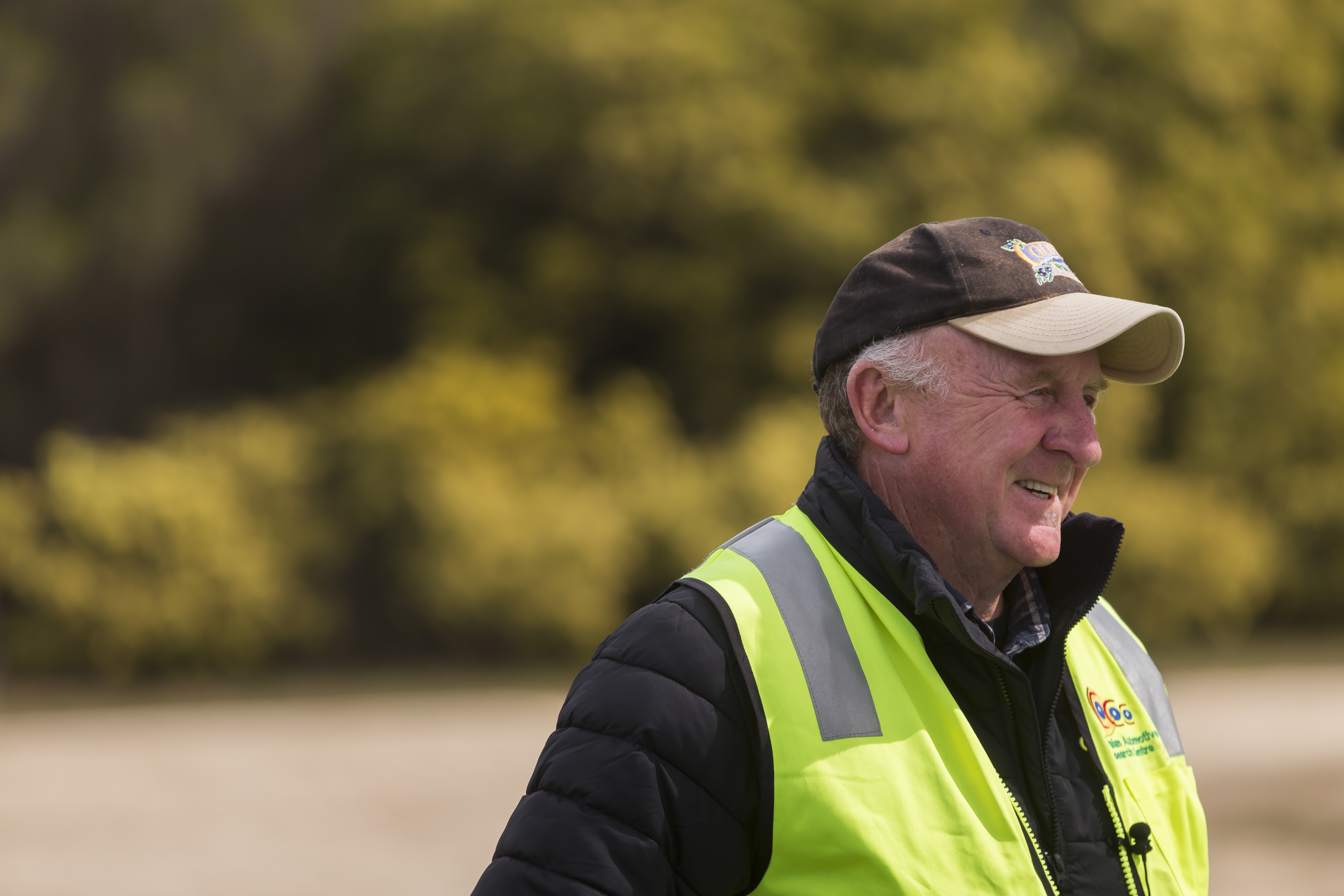


The world of trucks and machinery is saturated with self-made success stories. Often tucked away in quiet little towns, they are the stories of men and women who build remarkable enterprises from little more than the drench of sweat and an inherent capacity to simply crack on, have a go and critically, stay focussed. Meet Michael Smith
Spearing north-west from Kyogle, the Summerland Way wanders through verdant valleys massaged and moulded over millennia by the high reaches of the Richmond River.
Soon enough though, the road twists and rises sharply aside tall forest in the foothills of the rugged Border Ranges where, with the ancient core of Mt Lindesay staring down from an ageless Dreamtime, rambling ridgelines mark the boundaries of New South Wales and Queensland. Or in the belligerent tribal parlance of modern sporting rivalries, blue cockroaches one side, maroon cane toads the other.
After a long, curving climb up the range there comes an abrupt choice: Hook right to cross the border into toad territory or turn left down the valley towards the quaint little farming town of Woodenbong, population 500 or so.
For me it all boiled down to the fact that I couldn’t see any way of making money by staying at school.
Among these proud country folk is a smattering of Smiths while on the descent into town it’s impossible to miss the eye-catching entrance to a cattle property called ‘Adrigoole Angus’. It’s soon apparent that one is firmly connected to the other, but we’ll get to that shortly.
Smith, of course, is a common name in just about every town in the western world, but around here it’s also part and parcel of Woodenbong’s farming fraternity, born and bred.
Yet there’s one particular Smith whose passion for pasture and inherent liking for livestock are dissected along lines far more diverse and, to be blunt, manifestly more mechanical.
His name is Michael Smith and a little way out of town on the manicured and levelled brow of a small hill there’s a prominent sign marking the headquarters of the M.J. Smith Group.


A little way out of town on the manicured and levelled brow of a small hill there’s a prominent sign marking the headquarters of the MJ Smith Group
From here, standing on the path between a tidy yet somewhat nondescript office and possibly the most clinically clean workshop in existence, Michael Smith looks across the valley and points to a heavily timbered ridgeline where the state border staggers along the ranges.
Woodenbong might sit more than 800 kilometres north of Sydney and only 140 kilometres from Brisbane, but when asked a little later what colour he bleeds at certain times on the sporting calendar, it’s a smiling and certain Michael Smith who says in an instant: “Blue all the way mate. I know what side of the border I come from.” Loyalty runs deep and as the discussion unfolds, it obviously goes far deeper than just sporting preference.
From the same spot, he nods the other way to a modest farmhouse in the paddock next door. This is home where wife Jessica, 11 year-old son Jack and eight-year-old daughter Bobbie are never far from mind or view. The family bonds are strong and by his own admission, “I’m not sure how I’d go without Jess. She’s my strength.”
School holidays are in full swing when we talk and Jessica, a local school teacher, has taken the kids for a short holiday to the coast while Michael does what comes so naturally. Work! Still, “I’ll be glad when they’re back,” he says as much to himself as anyone else.
Our parents weren’t ones to hand you money mainly because they didn’t have a lot but they were very good at helping us in other ways.
Six years have passed since we first met in Kyogle and as before, his welcome is warm, the smile wide and the handshake strong. Other than the facts that we’re now talking in Woodenbong rather than Kyogle and both of us are perhaps a portion more portly than before, little seems to have changed.
Like, this is the same bloke with a truly amazing story of resilience, determination and an uncompromising work ethic based entirely on the pursuit of quality fuelled by a deeply etched credo which espouses, “There’s money in sweat.”
In a nutshell, it all started when a 12 year-old Michael Smith started selling eggs in the local district. Shops, the pub, door-to-door, it didn’t matter. It was a way to earn a dollar and so good was the ‘earn’ that by the age of 13, he’d left school. “And almost all of it was cash,” he adds with a shrewd grin.
Now in his early 40s, a soft smile and shrug signal a sense of gratitude that so much has been achieved and equally, there’s an unmistakeable regard for the staunch support of farming parents who ultimately accepted the fact their son’s future probably would not be forged in the classroom. Still, as he revealed some years back, leaving school so early was no easy sell.


The family bonds are strong for Michael Smith with his wife Jessica, 11 year-old son Jack and eight-year-old daughter Bobbie never far from mind or view
“For me it all boiled down to the fact that I couldn’t see any way of making money by staying at school.” School was okay but it was getting in the way of what the young Smithy considered his ‘real’ education.
Nonetheless, it certainly wasn’t a straightforward case of arriving home one day and announcing ‘I’m leaving school’. As Michael put it, “Mum and Dad were not pushovers.”
Parents John and Maree are still beef farmers in the Woodenbong district but back then, Mum was also an assistant school teacher, meaning the young man’s initial pleas about an early move from the school yard to the fowl yard were not quite as readily received as he might have hoped.
Even so, he had a case. Without putting too fine a point on it, school learning and student liaisons were not his forte. Nor was bullying uncommon, adding to the fervour for a life beyond school books.
Dad would let me use tractors and machinery to do things like share farm, to grow a crop of corn with someone.
Moreover, he certainly wasn’t lazy and had already shown that he could at least achieve a reasonable income from an egg enterprise which had the distinct advantage of cheap grain for his quickly growing flock of fowls – up to 600 birds at one stage – thanks to Dad’s ample supply of stock feed.
To cut a long story short, and no doubt delete much of the impassioned and occasionally emotional bartering between son and parents, Michael was allowed to leave school on the proviso that he undertake tutoring that would eventually see him achieve reading and writing abilities to Year 12 standards. “And I did that,” he says with more than a hint of pride.
However, by the age of 18 a childhood fascination and natural affinity with machinery were fast evolving into a desire for new endeavours.
“Our parents weren’t ones to hand you money mainly because they didn’t have a lot but they were very good at helping us in other ways.


A well-used D7 ‘dozer acquired as a teenager was followed by an excavator and by his 20th birthday, Michael Smith’s future was firmly forged in diesel and dirt
“Dad would let me use tractors and machinery to do things like share farm, to grow a crop of corn with someone.
“He would encourage it and that was good because I was doing something I really liked and earning money from my own work. The harder I worked, the more I could make.”
By his own admission, they were decisive days. Ultimately, the determined teenager became the proud owner of a well-used D7 ‘dozer which he put to good use clearing country on his parents’ property and soon after, working in local plantation forests.
Not much later the ‘dozer was followed by an excavator and by his 20th birthday, Michael Smith’s future was firmly forged in diesel and dirt.
I suppose I’ve always had a goal to grow in business and by ’04 we’d made the decision that we’d concentrate on dozers, diggers and trucks
“I suppose I’ve always had a goal to grow in business and by ‘04 we’d made the decision that we’d concentrate on dozers, diggers and trucks,” he says thoughtfully.
However, parental guidance was still having a profound influence on an inherently entrepreneurial spirit.
Smith senior was of the opinion that borrowing “a fair bit of money” to buy land would not only ensure his son knuckled down but also create a future beyond machinery. Accordingly, “We bought a little farm just west of here, bought some Angus cows and started in the beef business. It just grew from there,” Michael explains.
Nowadays, ‘Adrigoole Angus’ is the centrepiece of a farming enterprise holding an annual weaner sale from the offspring of 800 Angus breeders spread across 1,740 hectares (4,300 acres) held by Michael and Jessica Smith. Dad’s advice certainly didn’t go astray.


Encouraged by his dad, Michael bought a little farm and a few Angus cows and started a beef business which has grown into a significant enterprise in itself
Even so, “The main part of our business is still earthmoving, road building and civil construction, and trucks are largely what have chained it all together.”
Indeed, with the requirement for trucks quickly increasing in the group’s formative days, Michael formed a close relationship with the Brown and Hurley dealership in Kyogle, first with the purchase of a used Kenworth T480 prime mover for hauling earthmoving machinery between sites and from then on, a range of new Kenworth models have been integral to the group’s various workloads.
“It’s a genuine family thing with Brown and Hurley and that counts for a lot with me,” he says with absolute sincerity.
And more to the point, “We don’t scrimp on the types of truck we buy,” perhaps best typified nowadays by top-shelf Kenworth T9s on truck-and-dog duties and over more recent years thanks to a similarly strong association with Southside Truck Centre in Lismore, various Volvo models from utilitarian FM and FMX units up to the flagship FH 700 for heavy haulage work.
The main part of our business is still earthmoving, road building and civil construction, and trucks are largely what have chained it all together.
Somewhat surprisingly though, he insists, “We’re not a truck business. We’re a construction business that needs trucks.”
But that’s not to suggest trucks are a secondary interest, particularly when you see Michael’s passion for a stunningly restored V8 Mack Super-Liner sitting in the service bay.
He is, however, quick to explain that in earlier days tippers were hired from local company J. Watson & Sons until around 2007 when in mutual agreement, Michael acquired the Watson’s relatively modest truck business.
Again, close personal relationships figure highly in the Smith mindset. “The Watson family has always been very good to me,” he says earnestly, “They’re good friends.”


For the past six years or so, Michael Smith and close mate Rod Watson have been partners in a burgeoning fuel distribution business, Diversified Fuels
In fact, for the past six years or so, Michael Smith and close mate Rod Watson have been partners in a burgeoning fuel distribution business, Diversified Fuels. “Rod and his wife Kim have the service station and mechanical workshop in town and we initially started the fuel business to ensure supply for our own needs,” Michael explains.
“In that time though, it has grown from a one-truck operation to three trucks but Rod and Kim run that business. It’s entirely separate to what I do,” he emphasises before adding with a wry smile, “I only turn up for the Christmas party.”
Quality over quantity
Seated in the workshop, the smile quickly shifts to a serious expression when he’s asked what else has changed in the past six years.
Sure, the Kyogle workshop and grain storage depot where we first met have now gone. So, too, have the forestry work and much of the bulk commodity sides of the business been deleted from a core portfolio that nowadays focusses largely on civil construction, quarrying, earthmoving and heavy haulage roles. In effect, the type of work that founded the M.J. Smith Group in the first place.
I wanted a better business more than a bigger business. We’d grown past the peak of where we ever really wanted to be and I just needed to pull things back a bit, take more control. I’ve now done that.
More to the point, however, a blunt Michael Smith concedes the business simply grew too big. With around 120 people on the books at one time including about 20 contractors, the high bar he’d set for quality of people and workmanship was teetering.
“I wanted a better business more than a bigger business,” he said emphatically. “We’d grown past the peak of where we ever really wanted to be and I just needed to pull things back a bit, take more control. I’ve now done that.”
In equipment terms, the big slash came with a sale in January this year of around 50 assets – trucks, graders, dozers, rollers, water carts, floats, even things like portable lunch rooms. “We sold anything where we never had a long term, full-time person in the seat. It was as simple as that.”
As for perceptions among clients and suppliers that the sale pointed to a struggling business, Michael agrees it was a potential problem but concerns were soothed by candidly explaining the reasons for the cut-back and the desire to enhance quality and efficiency. “It was just a case of being honest and up-front with people,” Michael asserts. “We were never in trouble but I didn’t want to get into trouble either.”


The fleet now comprises truck-and-dog combinations, eight-wheeler water carts, a powder spreader, three float trucks, and a couple of smaller tippers
Justifiably, he cites an exceptional workshop area as a significant showcase for the business and the standards it evokes. “You only get one go at a first impression,” Michael contends. “We don’t have a big flash office but when our clients come here they walk into the workshop and hopefully, like what they see.
“Sure, I’m fussy about things being clean and tidy whether it’s the workshop, a truck and even slashing the paddock (and) I believe when people come in here, into the workshop, they can see what we’re about as a company and as a group of people.
All up, he says succinctly, the changes have been “simply better for business” with around 60 staff and 20 sub-contractors now on the books, and a highly utilised equipment fleet of truck-and-dog combinations, eight-wheeler water carts, a powder spreader for on-site work, three float trucks that also pull powder tankers, a couple of smaller tippers and “about 40 pieces of yellow equipment, mainly graders, rollers, water carts and stabilisers, all serving dedicated construction teams”.
“Our people are happier too,” Michael enthuses. “People are our business whether they’re staff or clients. It’s about quality more than quantity.
The main part of our business is still earthmoving, road building and civil construction, and trucks are largely what have chained it all together.
“To get a start here you first have to be a good person and probably have the same morals as us, then comes attitude and ability.”
Morals? “Yeah, by that I mean you have to look after yourself and your family,” he explains. “Home and family have to come first because if that’s not right, then work probably won’t be right either. That’s something I’ve definitely learned since the last time we met. It’s important to any business.
“It’s not always an easy place to work. When we’re flat out, 14 hour days are the norm but we try to have five big days and not touch the weekends. It doesn’t always go that way but we always try.”
Quiet for a moment, Michael continues, “We’re really happy, exceptionally happy with where we’re at now.


There’s also about 40 pieces of yellow equipment, mainly graders, rollers, water carts and stabilisers, all serving dedicated construction teams
“We’ve been 20 years in business and the majority of our workforce is 10-years-plus and there’s plenty now around 15 years and more.”
As for the future, a seemingly satisfied Michael Smith says the business balance is now “pretty much right” and it’s a satisfaction that extends to depots at both Woodenbong and further afield at Dalby in Queensland.
“We have the right people in the right places,” he says with total conviction. “They’re the ones who keep the company ticking, for sure, and you can’t lose sight of that.”
So, will the company grow again? His answer was cautious. “I’d be open to it if the right opportunities were there and I had the right people to put in place but at this stage, the answer is probably ‘no’.”
Home and family have to come first because if that’s not right, then work probably won’t be right either.
“The way I see it, we’re in a bit of a volatile market at the moment because things have been good for so long. I hope I’m wrong but sooner or later, I think most businesses could be in for a bit of pain.
“Our aim right now is to get even better at what we’re doing.”
Finally, in what probably amounts to a classic case of fruit falling close to the tree, it appears son Jack is following in Dad’s footsteps with chooks and eggs. So, any chance he might leave school at 13?
“I doubt that’ll happen,” says a smiling Michael Smith. “The big difference this time is that I’m the one paying for the feed.”


